
.png)
.png)
In the current 2026 subscription market, a failed payment is often the first step toward a lost customer. For B2C brands, the challenge is no longer just about sending a reminder email; it’s about ensuring the transaction succeeds without the customer ever knowing there was a problem.
When it comes to the Redux vs Butter Payments vs Revaly debate, the choice usually comes down to your tech stack. If you are a high-volume B2C brand running on Stripe, Redux Payments is the clear favorite because it acts as a silent "set-and-forget" layer. For those with complex or multi-gateway enterprise setups, Butter Payments remains a strong contender, while Revaly provides deep technical optimization to prevent declines at the source.
Choosing the right partner means deciding how you want to handle your customers' friction. Redux Payments, Butter, and Revaly all solve the same problem, but they approach it from different angles. Some platforms view payment recovery as a "silent" data engineering task happening entirely in the background, while others treat it as an optimization layer that bridges the gap between your billing engine and the banks.

Redux Payments is more than just a simple add-on for Stripe. It’s a sophisticated optimization layer engineered specifically for high volume B2C brands. While other enterprise tools often require months of engineering work, Redux delivers that same technical depth through a streamlined deployment that integrates directly into your existing Stripe stack.
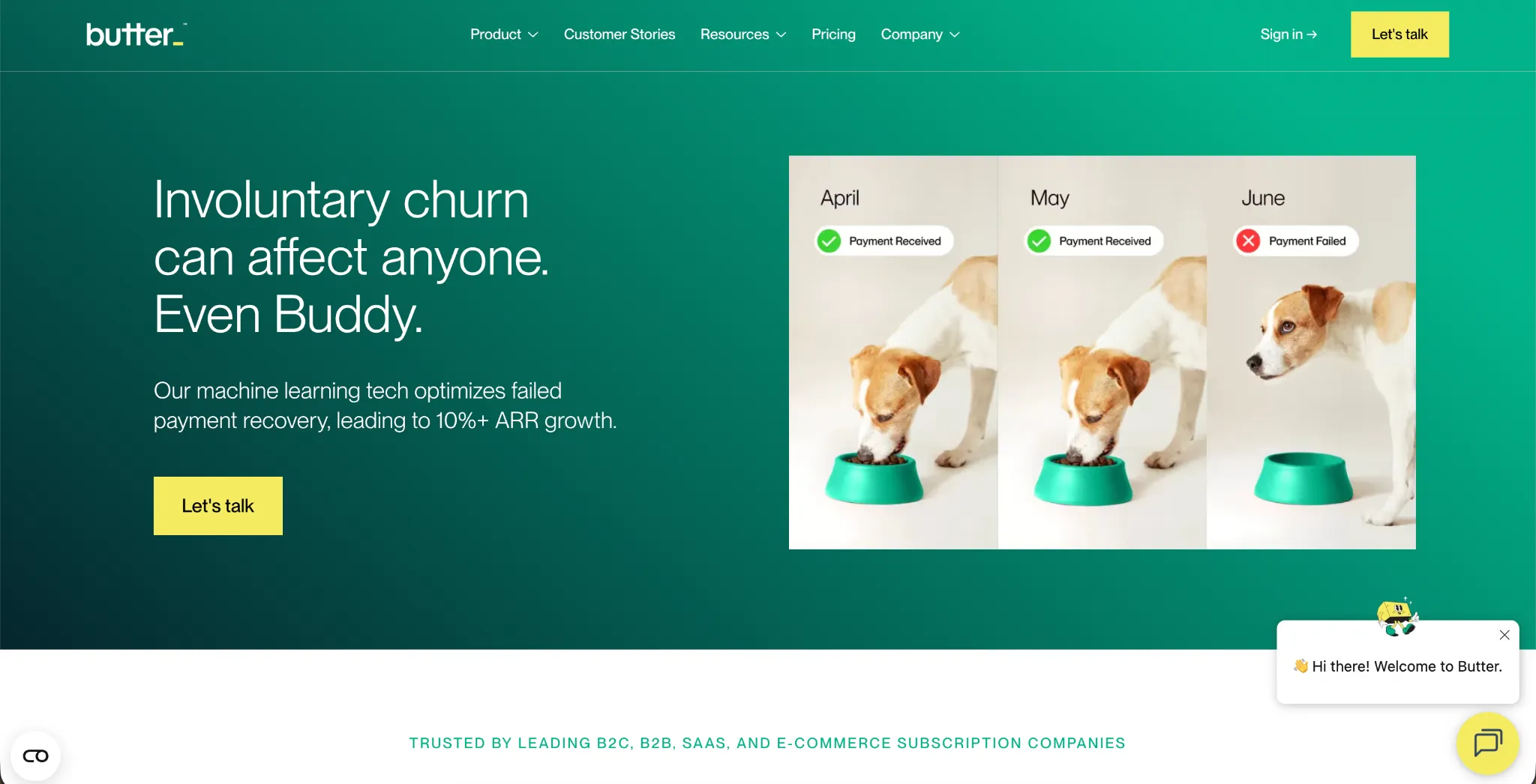
When weighing Redux vs. Revaly vs. Butter Payments, Butter is the data‑science choice for enterprises, especially those operating across multiple processors and regions. It acts as an ML optimization layer, improving the technical conversation between your gateways and issuing banks on top of providers like Braintree and Adyen. This is useful for international companies that need to reduce accidental churn caused by gateway‑level errors and bank connectivity issues in stacks that are too complex for manual tuning.

Formerly FlexPay, Revaly focuses on the technical “handshake” between merchants, processors, and issuing banks. It uses issuer and network intelligence to tune each transaction, fixing issues like address mismatches, formatting errors, outdated tokens, and routing, to better align with a bank’s approval logic. When a legitimate payment is still declined, Revaly selectively retries it using machine‑learning‑driven strategies.
In 2026, the best AI payment recovery strategies prioritize retention by removing as much manual effort as possible. Every time you ask a customer to take an action, you're adding friction, and in the B2C world, more friction means a lower chance they'll actually complete the update.
Redux’s Silent Recovery handles this by using an AI engine to analyze 100+ signals, determining the highest probability window for bank approval without any user input. This background fix keeps your revenue flowing without ever involving the customer, reaching out with active dunning only when it’s absolutely necessary. If you’re comparing Redux Payments vs Butter Payments, Redux’s ability to act as a frictionless extension of Stripe is its biggest edge for B2C brands. For those looking for Butter Payments alternatives, the Pay on Lift model makes Redux Payments a capital-efficient choice that ensures you only pay for incremental growth.
In a Redux vs Butter Payments comparison, Redux is a no-code optimization layer for Stripe users, while Butter is an enterprise engine built for multi-gateway setups.
No. Redux is an official Stripe partner that connects via the App Marketplace in under 30 minutes with no coding.
Silent Recovery uses AI to fix payment issues behind the scenes by communicating directly with the bank and the payment processor. Dunning is the manual process of emailing customers to ask for credit card updates.
Redux Payments. Its B2C-specific AI and "Pay on Lift" pricing make it the most capital-efficient of the Butter Payments alternatives.
Butter typically uses a revenue-share model. Many brands prefer Redux’s guarantee, which ensures you only pay for the revenue recovered above your current Stripe baseline.
If you're on Stripe, you're likely losing 20-40% of your revenue to avoidable failures. Redux provides the specialized intelligence to recover that revenue silently.
Book a Demo with Redux Payments and see exactly how much revenue your current baseline is leaving on the table. Only pay for the results we deliver.

.svg)
.svg)


.png)
